
Does more reflection time actually help?

Some people spend an hour every evening with a notebook.
Some people talk to a coach for an hour once a week and do nothing in between.
Which of them gets more out of their work?
We built Reflection Cloud on a simple conviction: you shouldn't need a lot of time to think well. So "more is better" was never our answer. But that left the real questions open. How much? Where does the time come from? Where should it go? We went looking for research, and the research doesn't say.
This article is how we think about it, how we built the product around that thinking, and how we'd suggest using it.
Can you say "more is better"?
There is research on writing. A meta-analysis of 146 studies on expressive writing — writing about difficult experiences — found that people who wrote three or more times, and for fifteen minutes or more per session, tended to see larger effects.
But in those studies nobody was giving up work hours to write. Participants wrote outside their jobs, and the effect was measured on top of everything else. So the research can say "if it costs you nothing else, more helps." It can't say anything about the trade that matters at work: an hour spent reflecting is an hour you could have spent doing.
That trade is the question most workplaces actually have. We couldn't find a study that measures it.
There is a sweet spot, even without data
One thing holds without any study.
A day has twenty-four hours. Add reflection time and, at some point, you're taking it from doing. Push it to the extreme — reflect all day — and you run out of things to reflect on. If too little doesn't work and too much doesn't work, the useful amount is somewhere in between. Draw it and you get a hill.
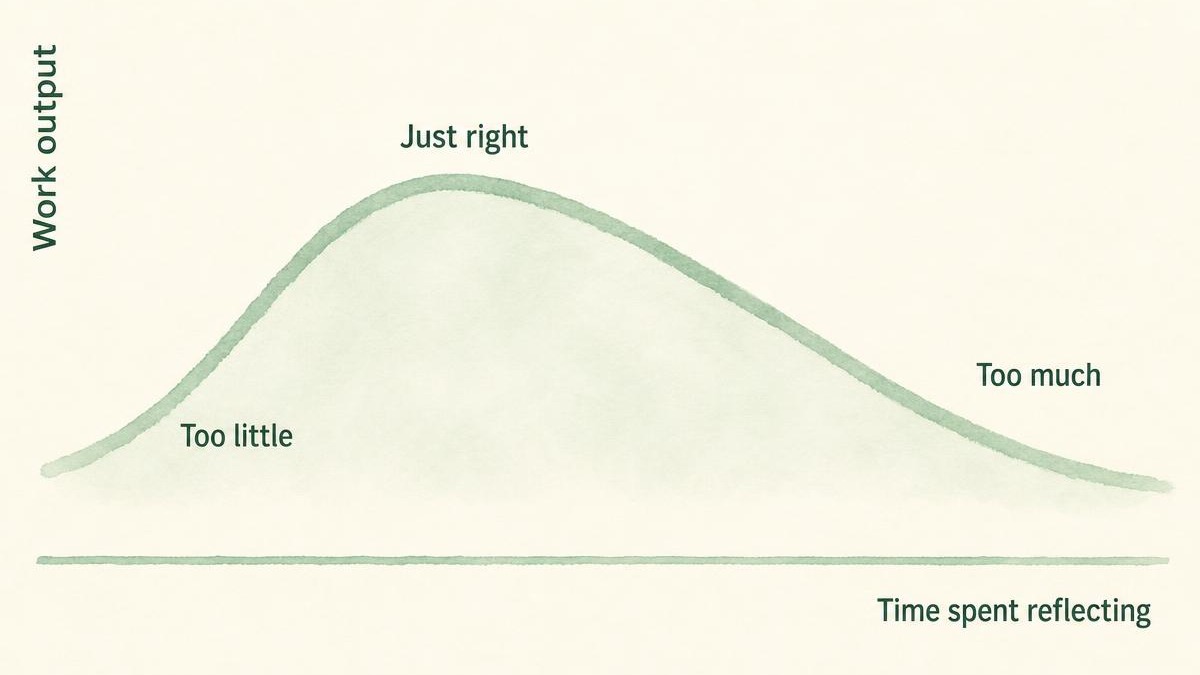
The two sides of the hill fail for different reasons.
- Too little: the next day arrives before you've recalled the last one. In this range, more really does help, because there are still untouched events to look at
- Too much: you run out of events before you run out of time. Reflection without fresh material drifts toward rumination — turning the same thing over again. And past that point, every extra minute comes straight out of the work
So we don't say "reflect more and you'll do better." Only the left side of the hill is true.
How much is realistic, then?
Nobody has measured where the peak is. So instead of starting from the amount, we worked backwards.
Suppose the reflection time comes out of the working day — nothing replaced, just added. On an eight-hour day, twenty days a month, four hours of reflection a month means the remaining hours have to produce about 3% more for the time to pay for itself. Six hours a month needs a bit over 4%. Eight hours needs close to double the original 3%.
How big is 3%? A 2025 meta-analysis pooled 81 randomized trials of workplace digital mental-health programs — about 25,500 people. Converting its reported effect sizes onto the scale we use (a single question about your own work performance) gives roughly 3% to 4%. Those studies measured symptoms, not productivity, and none of them measured Reflection Cloud. But they give the order of magnitude that this kind of program has actually reported.
So four hours a month sits just under what the research reports — near the top of what's reachable. Six hours edges over the range. Eight hours clears it by a wide margin: not impossible, but it assumes a serious, deliberate effort.
Everything above assumes the hardest case: that the time is created from nothing. In practice, it doesn't have to be.
You don't need to add the time
Every workplace already spends time on thinking, looking back, and talking. End-of-day updates. The first five minutes of standup. Weekly status notes. The retro. The 1:1. The performance review. Each of the four jobs reflection does already has a slot on the calendar.
| Job | What's already there | In Reflection Cloud |
|---|---|---|
| Daily | End-of-day update, start of standup | Check-in / Check-out |
| Weekly | Weekly status note, the "look back" slot in the team meeting | Self Reflection |
| Two people | 1:1, mentoring | Pair Reflection |
| Milestones | Performance review, goal setting, self-assessment | Dream Support / Life Navi |
Instead of adding time, swap it. Then no working hours are lost, and the "3% more from the remaining hours" condition disappears. Whether four hours of reflection can fit inside the existing schedule is, we think, the single thing that changes the outcome most.
One line to draw when you swap. Replace only the time that was for the person. An end-of-day update also reports to a manager. Entries in Reflection Cloud belong to the person who wrote them — managers and the company can't see them. Where a report is genuinely needed, keep a line of facts and run the two side by side. Same with a 1:1 that has turned into a status meeting: keep that part somewhere else.
Where the time goes matters more than how much
So: you've secured the time. Where does it go?
The same "one hour a week" can be laid out several ways.
| Layout | Per week |
|---|---|
| Ten minutes every weekday | 50 min |
| One sixty-minute block, once a week | 60 min |
| Five minutes every weekday plus thirty on the weekend | 55 min |
The totals are nearly identical. The three are not the same thing. Daily time and weekly time do different jobs. That's why Reflection Cloud has a short daily feature and a separate longer weekly one, rather than one place to write.
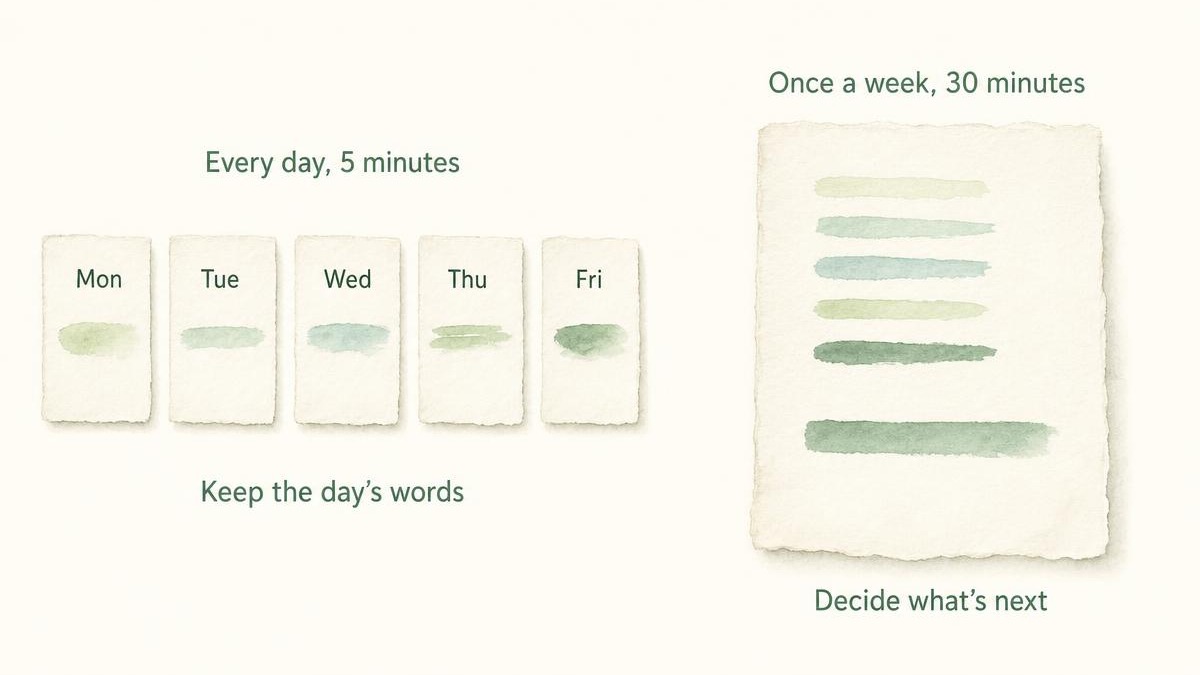
Daily time keeps the day's words
You can't reflect on what you can't recall.
Sit down once a week to look back and ask yourself what's actually retrievable. Tuesday has mostly faded by Sunday. What's left is whatever was vivid, plus the last day or two. It's easy to line those up and conclude "that's how this week went" — from a biased sample.
Five minutes on the day changes that. Put the day into a few words while the memory is still warm. It doesn't need to be deep. All it needs to do is exist, so it can be read later. That's what Check-in and Check-out are for.
Researchers at Harvard Business School ran an experiment in a call-center training program: trainees who spent fifteen minutes at the end of each day writing down what they'd learned scored 22.8% higher on the final test than those who didn't. It's a training test, not day-to-day productivity — but it's a clean demonstration of what writing on the day does.
Weekly time decides what's next
Some things five daily minutes can't show you.
"I'm stuck in the same place again." "I held back with the same person last week, too." Patterns like that aren't visible inside a single day. They only take shape when you lay several days side by side, look at them, and decide what next week should be. That's what the weekly thirty minutes is for, and it's what Self Reflection is built around.
This is where the daily minutes pay off. With five days of words in front of you, the whole thirty minutes goes to reading, connecting, and deciding. Without them, most of it goes to remembering. The daily five minutes change what the weekly thirty minutes are made of.
One report cuts the other way. In the expressive-writing meta-analysis above, spacing — daily versus weekly — made no difference to the effect. That's a specific task (writing about a painful event), not the "keep the day, read the week" pattern we're describing. But it's a reason not to overclaim what layout alone can do.
Morning or evening?
The daily five minutes can face two directions.
- Check-in, in the morning, decides how today will go. Five minutes facing forward
- Check-out, in the evening, keeps what happened. Five minutes facing back
Which fits depends on the shape of the work.
- Work where every day is different — sales, customer-facing roles, care — leans evening. Events churn daily, so capturing them the same day is worth the most
- Work where days look alike and focus decides the outcome — engineering, specialist roles — leans morning. Setting the day's focus first has the most direct effect on its density
If you can do both, two minutes in the morning on "here's what I mean to do" and three in the evening on "here's what happened" is, we think, the strongest combination. Read back on the weekend, the gap between intention and action is sitting right there.
Thinking alone, thinking with someone
The weekly thirty minutes can be solo or with another person. In Reflection Cloud that's Self Reflection versus Pair Reflection. Neither is better. They can do different things.
| Alone | With someone | |
|---|---|---|
| The questions | The app asks | A structured format asks, and the other person listens |
| A thin answer | You move on | The other person hears it |
| The words | Only need to make sense to you | Have to make sense to someone else |
| What you can bring | Things you can't say out loud | Things you can |
Two people go deeper because "eh, skip that one" doesn't work. Alone, it works fine. With someone across from you, a thin answer is audible in the room. And a decision said out loud tends to change next week's behavior more than one written down.
But some things only the solo session can hold. Trouble with your manager. Thinking about leaving. The parts of yourself you're not proud of. What can't be said to another person can only be taken in alone. Keeping personal entries invisible to managers and the company is partly about protecting that space.
Set the number of pair sessions by the 1:1s you already have
Pair time costs the other person's time, too. Run Pair Reflection inside an existing 1:1 and the thirty minutes are already paid for — nothing new on anyone's calendar. Add a weekly pair session in a team where 1:1s are monthly and you've created three new meetings a month.
So our suggestion: default the weekly thirty minutes to solo, and run it as a pair in the weeks where a 1:1 already exists. On effect alone, a pair every week would be stronger. Not every team can pay for that.
The mix changes by team
Here's how the pieces fit into the standard amount — one hour a week, four hours a month. The units are the daily five minutes (Check-in / Check-out), the solo thirty (Self Reflection), the pair thirty (Pair Reflection), and a sixty-minute milestone session (setting goals in Dream Support, taking stock in Life Navi).
| Team | Daily | Weekly | Milestones |
|---|---|---|---|
| Sales, customer-facing | 5 min, evening | 2 pair, 2 solo | — |
| Engineering, specialists | 5 min, morning | 3 solo, 1 pair | — |
| Care work, shift-based | 5 min, evening | 3 solo, 1 pair | — |
| Manager-heavy | 5 min, evening (about 4 days a week) | 3 solo, 2 pair | — |
| Junior-heavy, high turnover | 5 min, evening | 2 pair | 60 min monthly |
A word on why they differ.
- Sales and engineering differ only in the direction of the daily minutes. Work that changes with every conversation keeps the evening; work decided by focus sets the morning
- Care and shift work rarely lines up two schedules, so pair sessions are hard to book. Solo time covers the gap. The evening five minutes also keeps the day's feelings from carrying into the next shift
- Manager-heavy teams can be on both sides of a pair — listening in a 1:1 with a report, talking with a peer or their own manager — so pair sessions cost less new time here than anywhere else
- Junior-heavy teams with turnover lose the milestone tools if those are "for occasionally." People leave before occasionally comes around. Put it in the monthly slot
One variable cuts across every row. If people don't yet feel safe speaking up on the team, shift pair sessions toward solo. What can't be said only fits in solo time; add pair sessions before the room feels safe and you manufacture thirty polite minutes. Move them back when the room changes.
And if some form of this already works for your team, that's the one to keep. This table is for teams deciding from scratch.
What we'll measure next
We don't have numbers on effect by team. What's above is reasoning: how fast memory fades, whether "skip that one" is possible, how much a wrong direction costs, how many 1:1s already exist. The hill and the four-to-six-hour range are estimates worked backwards from the break-even, not a measured peak. This is how we built it and how we suggest using it.
So we'll measure. Reflection Cloud carries a single-question measure of work performance — rate the past four weeks against 100 for when you're fully well. Give two teams in the same role morning minutes and evening minutes respectively, run three months, and we'll be able to say "here's what happened for our users."
Nobody has that data yet. When we do, we'll rewrite this article.
Common questions
Isn't five minutes a day too short?
Not if the job is keeping the day's words rather than thinking deeply. Depth is the weekly session's job. Rather than stretching the daily five, we'd protect the weekly thirty.
Where is the time supposed to come from?
You don't have to create it. End-of-day updates, the start of standup, weekly status notes, 1:1s, reviews — time already spent on thinking, looking back, and talking. Swap those and you can reach four hours a month without shrinking the working day. Replace only the part that was for the person; keep the reporting.
Weekend or weekday for the weekly session?
The weekend gives distance and a wider view, but anything you decide waits two days to act on. Friday before you close the laptop keeps the week's context alive and feeds straight into Monday. Our Weekend Reflection Circle runs on Friday evening for the same reason.
I go in circles when I reflect alone
Turning the same thing over is what researchers call rumination, and they treat it as distinct from purposeful reflection. Three things help you break out: keep it short, take the question from outside instead of writing your own, and bring another person in.
You can move it later
Before asking whether to add reflection time, decide where the time you have should go. That alone changes what the same hours do. That's why Reflection Cloud is built as separate morning, evening, weekly, and milestone tools instead of one blank page — and it's the point of this article.
None of it is fixed. Solo to pair, evening to morning: you can move it. Start from the nearest row and revisit in about three months.
The amount can move, too. Light is two to four hours a month, standard four to six, ambitious six to eight. The table above is built on the standard amount, but starting light and adding when the material runs out is fine. Ambitious sits past the peak of the hill, so it assumes real commitment. As long as you remember that only the left side of the hill rewards more time, the amount can change along the way.
Research referenced
- Frattaroli, J. (2006). Experimental disclosure and its moderators: A meta-analysis. Psychological Bulletin, 132(6), 823–865. (146 expressive-writing studies. Number and length of sessions related to effect; spacing did not.)
- Di Stefano, G., Gino, F., Pisano, G. P., & Staats, B. R. (2014). Learning by Thinking: How Reflection Aids Performance. Harvard Business School Working Paper 14-093. (Fifteen minutes of end-of-day reflection and training performance.)
- Stratton, E., Morris, R., Milton, A., Deady, M., Choi, I., & Glozier, N. (2025). Optimizing Workplace Digital Mental Health Interventions: Systematic Review and Meta-Analysis. Journal of Medical Internet Research, 27, e71253. (81 trials, about 25,500 participants. Effect sizes of 0.17–0.21 on symptoms. The 3–4% in the text is a rough conversion using the standard deviation of a single-item work-performance measure.)
- Trapnell, P. D., & Campbell, J. D. (1999). Private self-consciousness and the five-factor model of personality: Distinguishing rumination from reflection. Journal of Personality and Social Psychology, 76(2), 284–304.
- Grant, A. M., Franklin, J., & Langford, P. (2002). The Self-Reflection and Insight Scale: A new measure of private self-consciousness. Social Behavior and Personality, 30(8), 821–836.
- Harrington, R., & Loffredo, D. A. (2011). Insight, rumination, and self-reflection as predictors of well-being. The Journal of Psychology, 145(1), 39–57. (Insight predicts well-being; self-reflection on its own does not.)
These are studies of writing, of how attention turns inward, and of workplace mental-health programs. None of them tests where reflection time should go, or the effect of Reflection Cloud. They're here as material for thinking, not as proof.