
Hansei is not the only Japanese word for reflection

If you've come across hansei (反省), it was almost certainly through Toyota.
It's a fixture of the Toyota Production System, and the usual gloss is accurate: recognize where you fell short, understand why, make sure it doesn't recur. A hansei-kai — a reflection meeting — is held even when the project succeeded, on the principle that there were failures along the way worth finding.
That's a real practice and a good one. This article isn't an argument against it.
It's about the fact that hansei is one of at least five Japanese words in this territory, and that English collapses all of them into "reflection."
Here's the part that surprises people, including us when we went back and checked properly: the words don't sort neatly by meaning. They sort by room. Which word gets used depends on where you're standing.
Five words, five rooms
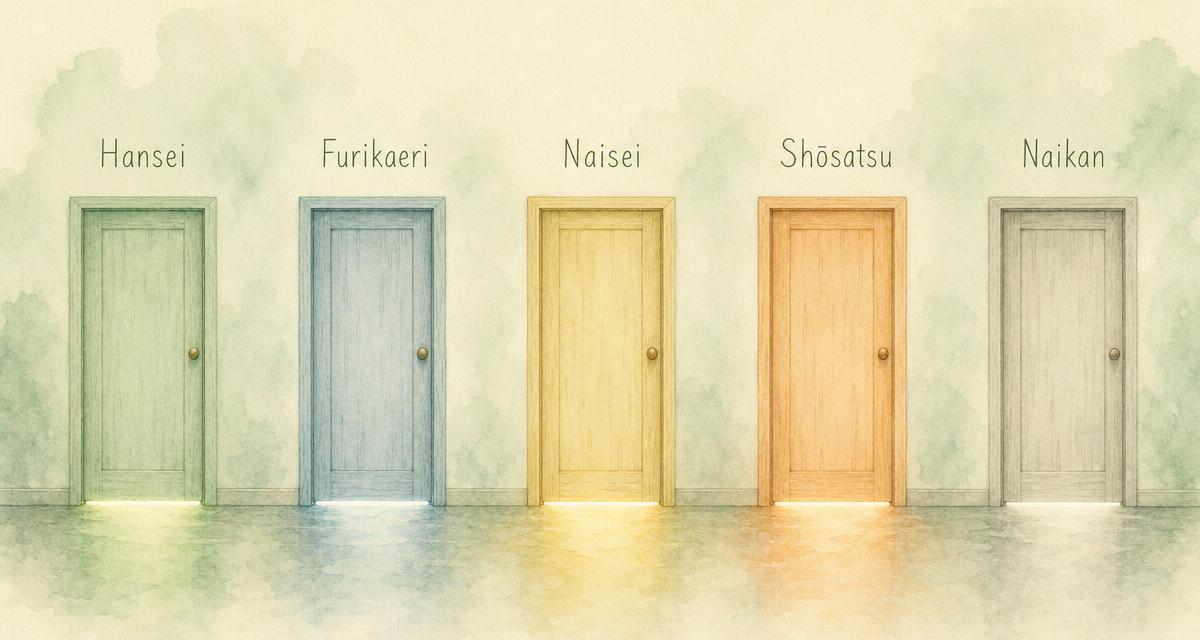
| Word | Where you actually hear it | What it leans toward |
|---|---|---|
| Hansei (反省) | The factory floor. Also school discipline — a hansei-bun is the essay a student writes after misbehaving | Examining whether past conduct was right or wrong. The dictionary says both, but usage pulls hard toward what fell short |
| Furikaeri (振り返り) | Classrooms. Japanese teachers end lessons with a furikaeri | Recalling what happened and sorting it. No failure assumed |
| Furikaeri — again (ふりかえり) | Software teams. It's the standard word for a sprint retrospective, usually written in hiragana to soften it | Same word, different room, and the spelling marks the difference |
| Naisei (内省) | Corporate training and HR. Naisei-shien — "supporting someone's naisei" — is standard vocabulary for what a manager does | Looking inward. At your own thinking and feeling, rather than at the error |
| Shōsatsu (省察) | Education research and teacher training. Donald Schön's reflective practitioner is 省察的実践者 in Japanese | Examining experience and making meaning of it. The most academically respectable of the set |
| Naikan (内観) | Clinical and Buddhist-derived practice. Also the old psychology term for introspection as a research method | A specific structured practice — see below |
None of these are mystical. They're ordinary words that happen to divide the territory more finely than "reflection" does.
A caveat worth stating, because we checked: in the dictionary these words overlap. Daijisen's entry for naisei literally ends with the word hansei. They are not crisply opposed terms. What separates them is usage, field, and the direction each one leans — which turns out to matter more in practice than the dictionary does.
Why the distinction is practical
Hansei is well matched to a defect. Something didn't meet the standard, the standard is known, and the point is to close the gap. In that setting, starting from what fell short is simply efficient — and holding a hansei-kai after a success, to find the failures nobody noticed, is a genuinely rare discipline.
Now run the same procedure on your own life, nightly.
Every evening, you compare where you are against a standard you haven't met, and look for what to fix. Do that for a month and it isn't quality control anymore. It's an audit with you as the only auditee.
There's research that maps onto this closely. Psychologists separate brooding — repeatedly measuring yourself against a standard you haven't reached — from reflection, which moves toward understanding what happened. Brooding is the one that tracks with depression. The two are easy to confuse from the inside, because both feel like taking yourself seriously.
A practice tuned for finding defects, applied to a person, finds defects. That's not a flaw in hansei. It's a mismatch between a tool and a use.
So which one are you actually doing
Try it on tonight.
- "What did I get wrong today, and how do I stop it happening again?" — hansei
- "What actually happened today?" — furikaeri
- "What was that like, and what does it mean for me?" — naisei
All three are legitimate. They end up in different places, and most people asking themselves to "reflect" are running the first by default — because in English, "reflecting on your day" already sounds faintly like an inspection.
The criticism of the word we chose
Here's where we have to be straight about something.
We build a reflection app, and in Japanese it sits in the category 内省アプリ — a naisei app. That was a choice. And in Japanese education research, there is an established argument that naisei is the wrong word.
The case goes like this: as a translation of "reflection," hansei is too critical, furikaeri stays stuck in the past, and naisei is too narrowly inward — concerned only with your own interior, when reflection in Dewey's or Mezirow's sense includes making meaning of experience, understanding other people, and moving toward action. On that reading, shōsatsu is the better word, which is why it's the one teacher-education literature uses.
We think that criticism is correct. Naisei really does lean inward, and inward alone isn't enough.
Two things follow.
One: the word was chosen for recognition, not precision. Shōsatsu is the better term and almost nobody outside education research uses it — ask a Japanese person on the street and you may get a blank look. A category label built from a word your readers don't carry doesn't describe anything to them; it just sounds academic.
So the choice was made among the words people actually have. Hansei comes with blame attached. Furikaeri is about the events, not the person. Naisei is the closest of the available words to what the app actually does — which is a naming decision, not a claim to have picked the theoretically correct term. We know which one that would have been.
Two: the gap the criticism identifies is closed in the design, not in the branding. The sequence the app uses is ORIMD — Objective, Reflective, Interpretive, Meaning, Decisional. It's the ORID facilitation method with Meaning added.
Look at the last two stages. Meaning and Decisional are exactly what "too narrowly inward" is missing — making sense of the experience, and ending with something you're going to do. The evening doesn't stop at noticing how you felt.
So: naisei as the word, with the shortcoming of naisei answered in the sequence. That's more honest than picking the more respectable word and hoping the design catches up.
Where the word shows up in the code
One more place, and it's small.
When you finish writing, the AI responds — but "you should" and "you need to" are prohibited across every prompt template. That isn't a tone preference. If the app opened with a verdict, it would be running hansei on you regardless of what we called it.
That's the reason this vocabulary is worth an article at all. It isn't linguistic trivia. It's the difference between two evenings.
One more thing about hansei
Nothing here says stop doing it.
If something went badly and there's a concrete thing to fix, hansei is the correct instrument, and the discipline of holding one even after a success is worth keeping.
The claim is narrower: hansei is not the whole of reflection, and running it as your daily default has a cost. Japanese hands you five words and lets the room decide. English hands you one, so the default got chosen for you.
Though it's worth noticing that having more words didn't make the choice free. We still had to name the thing with a word people would recognize, and that ruled out the most accurate one. Everyone picks from the words their readers already carry. You just happen to be carrying fewer of them here.
Reflection Cloud is a five-minute reflection app for mornings and evenings: answer a question, write a little. Free to use, and what you write is yours alone.
It's a naisei app — inward-leaning, and built to not stop there.
Further reading
Our developer writes at length about reflection on a separate blog, including the full ORIMD question set: 100 Questions to Deepen Your Self-Reflection Using the ORIMD Framework.
Research referenced
- Treynor, W., Gonzalez, R., & Nolen-Hoeksema, S. (2003). Rumination reconsidered: A psychometric analysis. Cognitive Therapy and Research, 27(3), 247–259. (The brooding/reflection distinction.)
This is research on self-focused thinking, not on Japanese vocabulary. It's used here to describe what a habit of starting from your own shortfall tends to do.
Dictionary senses are from Daijisen and the Nihon Kokugo Daijiten. The argument that shōsatsu is the better translation of "reflection" is the standard position in Japanese teacher-education literature, following Schön and Mezirow.