
Why journaling doesn't stick

There's a notebook in a drawer somewhere with eleven pages filled in.
You bought it in January. The first week went fine. Then a day got away from you, and then a second, and by the third you were doing arithmetic about how far behind you were. The notebook stayed shut after that.
We build a reflection app, and we've heard this story more times than any other.
The usual explanation is that you don't have the discipline. That explanation is a dead end, because the only thing it leaves you to do is try harder next January. So let's look at something else: what the people who keep writing actually have that you don't.
It isn't willpower.
You already had a reason
Before the how, the why — because there's a fact hiding here that matters.
Almost nobody starts a journal without a reason. Ask people what made them buy the notebook and you get some version of these three:
- I don't want to forget. The good days and the hard ones both blur inside a week.
- I want it out of my head. Thoughts circling at 1 a.m. settle down once they're on paper.
- I want to see myself change. You can't feel it day to day, but six months back you were someone slightly different.
That third one is worth pausing on. It's the only thing on the list that nobody else can hand you. Your own words from six months ago don't exist in any book or search result.
So: you had the reason on the day you bought the notebook, and you still stopped. Which means the missing piece was never motivation.
Before we get to what it was, one detour — because "just write more" is bad advice if writing doesn't do anything.
What the research actually shows
Writing has a real research literature behind it, and it's messier than the headlines.
The best-known work is James Pennebaker's expressive writing studies, starting in the 1980s. Write about something difficult for fifteen or twenty minutes a day, for a few days, without worrying about grammar or how it reads. In the original study, students who did that visited the campus health center less often over the following six months.
That finding launched hundreds of follow-ups, and they don't all agree.
| What was found | Which analysis |
|---|---|
| Moderate benefit | Early meta-analysis, pooling health and psychological measures |
| Small but real | Long-term follow-up analysis of depression, anxiety, and stress |
| No clear effect | Analysis restricted to randomized controlled trials |
| Larger benefit | Studies focused on specific groups, such as people with PTSD |
Same activity, different conclusions, depending on who was studied and how. Writing is not a treatment that works on everyone.
There's a second complication. Not all self-reflection points the same direction. Researchers distinguish brooding — comparing yourself over and over against a standard you haven't met — from reflection, which moves toward understanding a problem. Brooding tracks with depression. So writing can genuinely make a night worse, if the writing is the circling kind.
Here's where that leaves us. Writing has evidence behind it. It isn't magic, and the form matters. Which is exactly why the "how" is worth taking seriously.
The methods that last have already decided something
Look at the journaling practices that have survived decades and picked up real followings. Different philosophies, different tools — but they have one thing in common.
| Method | What's decided before you sit down |
|---|---|
| Morning Pages | How much. Three pages, longhand, every morning, no stopping. The quota removes any question of whether what you're writing is good. |
| The Five Minute Journal | What. The same prompts every morning and every night. You're not composing; you're answering. |
| Bullet Journal | The form. Symbols and short bullets. Permission to not write sentences is itself the thing that lowers the barrier. |
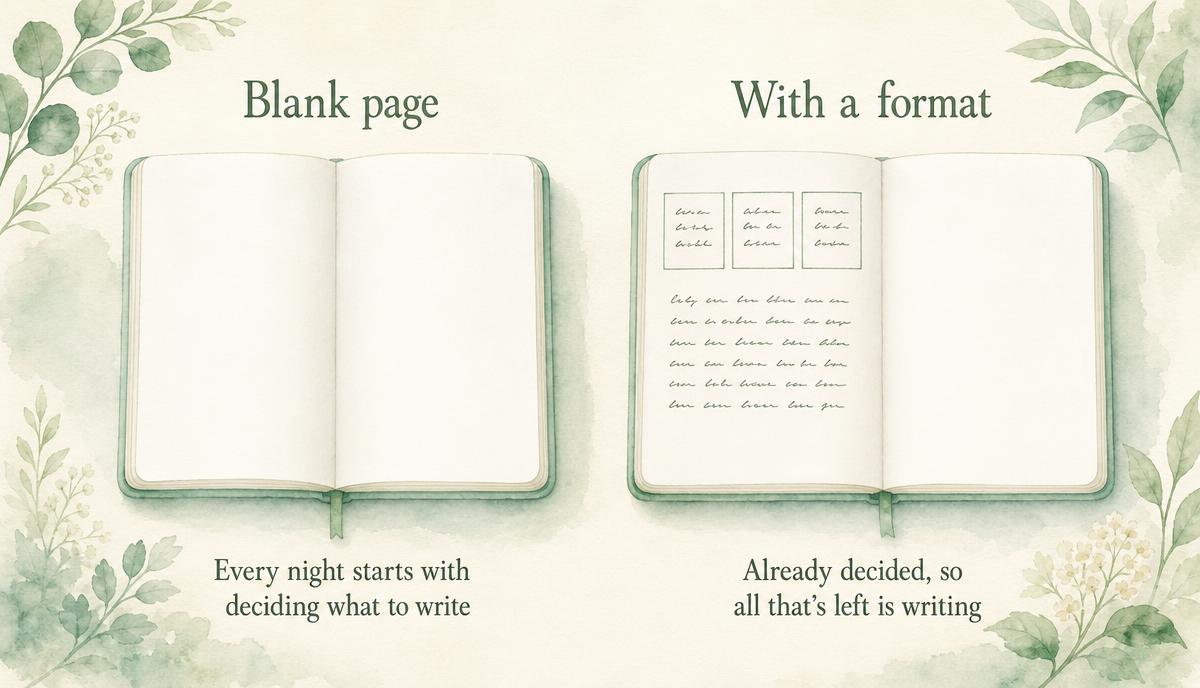
None of them ask you to be more disciplined. They each remove a decision.
That's what the people who keep writing have: a format. Not more resolve — one less thing to figure out at 11 p.m.
Which means buying a blank notebook and resolving to "write my thoughts every day" is asking yourself to design the exercise from scratch, nightly, forever. Stopping isn't a character flaw. It's the predictable outcome.
And to be clear: if one of these already works for you, stay with it. Someone whose hand moves across a paper page every morning has no reason to change tools. What we've spent our time on is the other case — the people who haven't found their format yet.
So here are three things worth dropping
The format is the main event. These three just clear the things fighting it.
What we did on the tool side
Everything above works with paper. Here's what we chose when we built the reflection app itself — read it as notes from people attacking the same problem from the tool side.
- We supply the format. Open it and the questions are there. In the morning: how you feel, why, what kind of day you want, what you want to get to. At night, questions that look back. You never write the first line yourself. Daily use is not assumed — morning and evening are places to go when you want them, not boxes to fill.
- We keep it short. Pick a feeling, write a few lines, done. Five minutes and you can close it.
- We don't punish gaps. No streak counters to protect, no notifications chasing you about the day you missed.
- Something comes back. When you finish, the AI takes in what you wrote and responds briefly. It won't tell you what you should do — phrases like "you need to" and "you should" are ruled out by design, because pressure is the thing we're trying to remove. It's a reply, not a verdict.
The tool doesn't keep you going. But a fair number of the conditions making it hard to keep going can be removed on the tool's side.
If doing it alone is the hard part
There's an assumption running under everything so far: journaling is a solitary act.
That's where its honesty comes from. Nobody's reading, so you can be straight.
It's also where most of the difficulty comes from. Nobody notices whether you wrote or not. What you write accumulates inside you and nothing comes back out.
So we built Weekend Reflection Circle, and since paper can't do this, it's worth describing.
- Friday nights at 9. People show up at the same hour and each write their own reflection. Nobody reads anybody's entry — you're alone together.
- When everyone's finished, the AI weaves that night's words into a single story, with an illustration and narration.
- Participants appear under animal names — fox, owl. No one knows who wrote what, which is precisely why people write honestly.
- Afterward you answer one question that came out of the story, and it closes with an epilogue. Forty minutes, once a week.
- Can't make Friday? Write during the week and your words are woven into the weekend's story anyway.
"The words I wrote this week came back to me mixed with strangers' words, as a story." That doesn't happen when you write alone. And something coming back turns out to be a reason people return.
We're not trying to strengthen anyone's willpower here. We're putting two things in place: an appointment — Friday night, that room exists — and a return.
About the days you can't write
They come.
We stopped designing for the person who writes every day a long time ago, because we kept talking to people who don't. Disappearing for a week, coming back, and writing only about today isn't a failed entry. It's a normal one. The notebook in the drawer can be reopened in the middle.
Reflection Cloud is a five-minute reflection app for mornings and evenings: answer a question, write a little. It's free to use, and what you write is yours alone. Weekend Reflection Circle is free too.
If what you need is a page that's never blank, use it as a format. If the hard part is doing it alone, use it as somewhere to be on a Friday night.
Further reading
Our developer writes at length about reflection on a separate blog. On why reflection keeps getting postponed in the first place: Why We Keep Putting Off Reflection.
Research referenced
The size of the effect is genuinely contested, so the list includes both supportive and unsupportive findings.
- Baikie, K. A., & Wilhelm, K. (2005). Emotional and physical health benefits of expressive writing. Advances in Psychiatric Treatment, 11(5), 338–346.
- Frattaroli, J. (2006). Experimental disclosure and its moderators: A meta-analysis. Psychological Bulletin, 132(6), 823–865.
- Meads, C., & Nouwen, A. (2005). Does emotional disclosure have any effects? A systematic review of the literature with meta-analyses. International Journal of Technology Assessment in Health Care, 21(2), 153–164. (Found no clear effect once restricted to randomized controlled trials.)
- Guo, L. (2023). The delayed, durable effect of expressive writing on depression, anxiety and stress: A meta-analytic review of studies with long-term follow-ups. British Journal of Clinical Psychology, 62(1), 272–297.
- Treynor, W., Gonzalez, R., & Nolen-Hoeksema, S. (2003). Rumination reconsidered: A psychometric analysis. Cognitive Therapy and Research, 27(3), 247–259. (The brooding/reflection distinction.)
These studies are about writing in general. None of them tested Reflection Cloud.