
How do you know a client has changed?

"Something's shifted in this one."
You notice it mid-session. The words come out differently. They push past a place where they used to stall. Even their face is different.
Then someone asks how you know that, and it's harder than it should be to answer.
They renewed. They're still showing up. They referred a colleague. All outcomes, none of them the thing itself. Confidentiality means you can't show the work. Satisfaction scores come back high, but "that was a good hour" is not "I'm different."
The hardest part of this work may be that the thing you care about most is the thing you can least demonstrate.
We're stuck in the same place
Our situation first, since it's the same one.
We build a reflection app called Reflection Cloud, and we can't prove that using it changes anyone. There's research on writing, the effect sizes are contested, and nobody has run a study on our product.
We could produce numbers. Retention, days written, satisfaction. Every one of them measures using the thing, not becoming different.
That doesn't mean there's nothing to look at. It means the trace is somewhere other than a number.
Change shows up in language
There's a body of research that examined the writing itself.
Pennebaker and colleagues analyzed what people wrote about difficult experiences and asked whose language predicted who got better afterward. In a 1997 report, greater use of causal words (because, so, why) and insight words (realize, understand, know) predicted better physical health later. Worth noting: no such relationship appeared for mental health. The effect isn't uniform.
In 2003, Campbell and Pennebaker came at it from another angle and found something different: what tracked with better outcomes was flexibility in pronoun use — moving between "I" and other perspectives rather than staying locked in first person.
Put together, what was happening over the course of change was this: fragmented emotional venting turning into a coherent account. And that was visible from the language side.
One line worth drawing clearly. These studies looked at associations with health measures. None of them validated language as a yardstick for depth of reflection. So this can't be turned into a score.
What it can be is something you'd notice on rereading.
| What to watch | What sometimes shows up |
|---|---|
| Length | How much comes out in answer to one question |
| Connectives | because, so, that's why start appearing |
| Insight | "I hadn't seen that until now," "put that way…" |
| Subject | Not only themselves — other people enter the account |
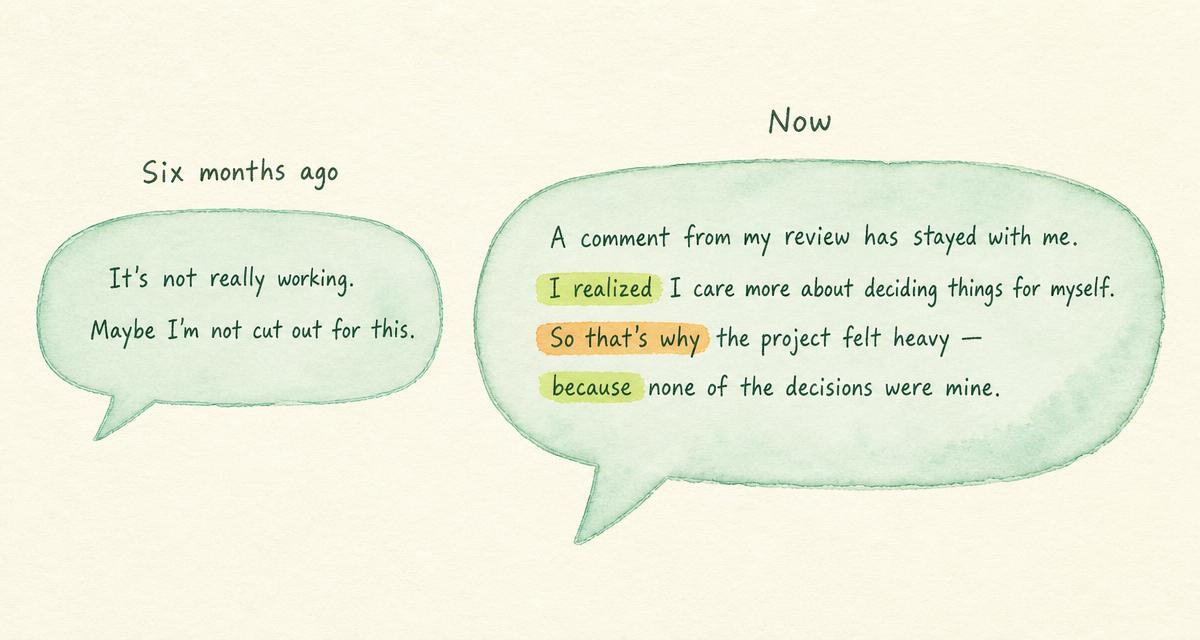
If you work alongside people, you've probably felt this already: ask the same question and something about the answer has changed. The point of this article is that the feeling isn't imaginary.
Which makes it a question of what's kept
If change shows up in language, the rest is a storage problem: are the earlier words still there, and can you put them side by side? That part a tool can carry.
Before the description, the boundary — because if you already run a practice management platform, this is the obvious question.
We're not in that category. Scheduling, invoicing, assignments, progress tracking: those tools optimize the running of a practice. What we work on is the client's own reflection habit, in the days when you aren't there. The two don't overlap, and swapping anything out isn't on the table.
Reflection Cloud has a feature called Pair Reflection — one reflection session two people run on a shared screen. Pick a theme, move through a structured sequence of questions, the listener offers feedback partway through, and the AI writes the summary at the end. About thirty minutes.
The record of that session stays with both of you. History can be filtered by theme keyword and sorted oldest-first. So filter on "career doubts," sort ascending, and the first session and the most recent one sit next to each other, readable. (Going back beyond the last month requires a paid plan; the free plan keeps a one-month window.)
What did they say to that question six months ago? What do they say to it now? You don't have to point at the difference. They can read it.
Being straight about the limits: we don't visualize the change. No word-count trends, no charts of vocabulary shift. Side by side and readable — that's all of it.
We also don't intend to move toward scoring it. The moment depth of reflection becomes a number, it becomes an instrument for grading clients. A tool built for accompanying someone getting used for evaluation is the outcome we'd least want.
What doesn't come back
The boundary, stated plainly.
What a client writes day to day is not visible to you. Not the content, not how often. What stays with both of you is only the session you did together.
What they bring, and how far they go into it, is theirs to decide. Being able to see someone's whole week would make some situations easier to support. It would also turn the place they write into a place they're being watched, and we judged that the larger loss.
When they say it in their own words
In the end, the reason a client renews — and probably the reason this work stays livable — is the moment they say, in their own words, that something has changed.
If their words from six months ago are sitting right there when they say it, it stops being an impression and becomes a confirmation. Not proof, not measurement. But the form of evidence that's most convincing to the person it's about.
That's the extent of what we're trying to do from the tool side. What to ask, what to do with the answer, what this person needs right now — that stays your work.
You can start on the free plan. Use it as your own reflection tool first, and if the questions or the responses don't sit right with you, tell us. Whether this meets the standard of work where you're holding someone's inner life is not something we can judge from here. Deciding not to use it is a legitimate outcome.
Research referenced
- Pennebaker, J. W., Mayne, T. J., & Francis, M. E. (1997). Linguistic predictors of adaptive bereavement. Journal of Personality and Social Psychology, 72(4), 863–871. (Insight and causal word use predicted later physical health; no relationship was found with mental health.)
- Campbell, R. S., & Pennebaker, J. W. (2003). The secret life of pronouns: Flexibility in writing style and physical health. Psychological Science, 14(1), 60–65.
Both studies examined associations between writing and health measures. Neither validated language as a measure of reflective depth, and neither tested Reflection Cloud.