
When your report says "I don't really have anything" in the 1:1

"So, how's it going?"
"Yeah, fine. Nothing major."
"Anything getting in your way?"
"No, I'm good."
And then there are twenty-five minutes left.
Managers tell us about this meeting more than any other. The program runs, the calendar holds, and the content quietly dissolves into a status update. Not bad enough to cancel. Just no longer obviously for anything.
One thing worth saying up front: the person who said "nothing major" is often walking away thinking they didn't say anything either. Neither of you is coasting. You both sat down wanting it to go well.
Where "nothing to talk about" comes from
Two different things hide under that sentence, and they need different responses.
| What you hear | What's underneath |
|---|---|
| "Nothing major" | They can't retrieve it. Nothing is coming to mind |
| "All on track" | They don't know what's safe. They're checking the range |
Neither is about drive or ability. Take them one at a time.
They can't retrieve it — open questions are hard to answer
There's a memory experiment from 1966 that describes this meeting almost exactly.
Tulving and Pearlstone had people learn a list of words, then recall them under two conditions: freely, or with category names supplied as cues. The group with cues remembered substantially more.
What came out of that is the distinction between available and accessible. The trace is intact in storage; without a cue, you can't reach it. Not forgotten — unreachable.
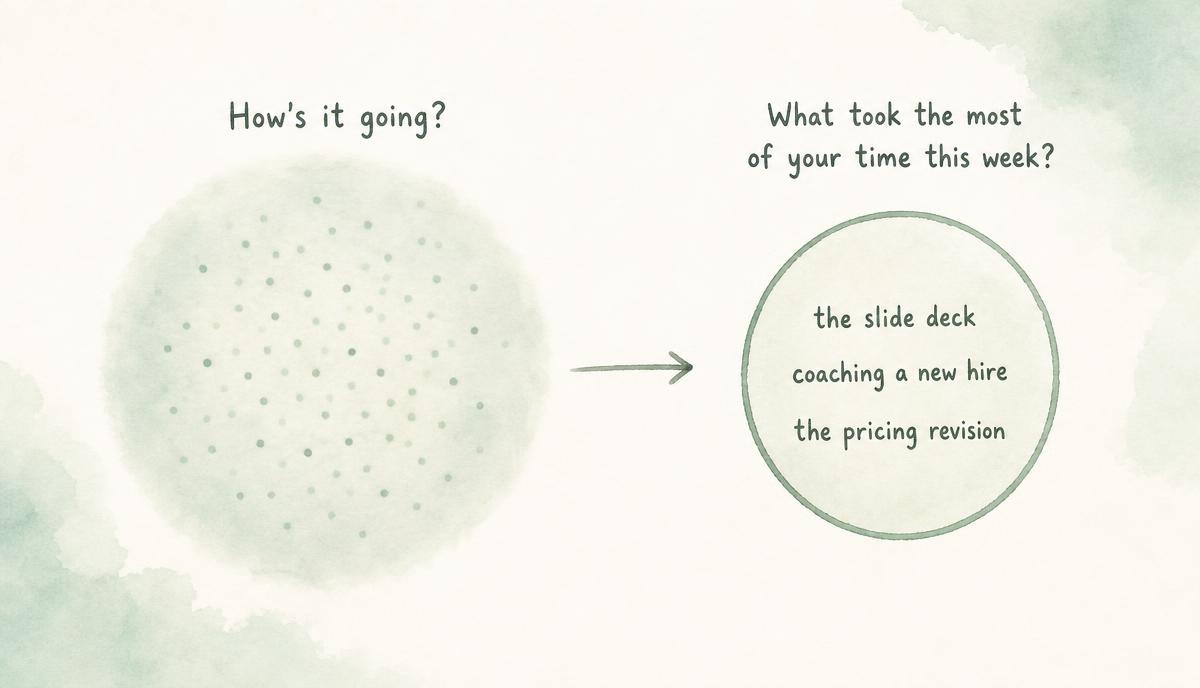
"How's it going?" is enormous and supplies no cue. Everything from the past week is in scope, and your report has to search it, judge what's worth raising, and put it into words. Retrieve, select, and articulate, simultaneously.
In front of the person who writes their review. In about three seconds.
"Nothing major" is what comes out when that search fails. It's the safest available answer.
They don't know what's safe — safety gets checked, not announced
The second case is when they can retrieve it and don't say it.
Amy Edmondson named the condition where people believe they won't be embarrassed, rejected, or punished for speaking up: psychological safety. Her 1999 study of work teams found that teams higher in it showed more learning behavior, and that learning behavior was what connected to performance. The finding people quote is that the safer hospital units didn't make fewer errors — they reported more of them.
Safety isn't a switch that's on or off. It gets checked, in this relationship, in this room, this time. Thirty minutes alone with the person who evaluates you is a setting with very little evidence available. Opening with something bland isn't suspicion. It's looking around.
Which is why meeting more often doesn't change the content
When 1:1s aren't working, the things that usually get adjusted are frequency, length, scheduling, and notes. Biweekly becomes weekly. An agenda template goes out. A tool arrives to keep a record.
None of that is wasted. But neither of the two things above moves an inch. Not being able to retrieve something doesn't improve with repetition. Unverified safety isn't resolved by the existence of a transcript.
What actually determines the content is two variables:
- The material brought into the room — how many words the other person already has
- How the time is run — what gets asked, in what order, and how the answer is received
And neither one carries the meeting on its own. Without material, good facilitation has nothing to dig into. With material, an interrogation still won't surface it. The responsibility sits about evenly on both sides.
What you can change on Monday — put a cue in the question
The facilitation side you can change in your next 1:1. The highest-leverage move is to replace wide-open questions with cued ones.
| The usual question | With a cue attached |
|---|---|
| How's it going? | What took the most of your time this week? |
| Anything blocking you? | That thing you mentioned last time — where did it land? |
| Anything you want to raise? | What took longer than you expected recently? |
| All good? | Where did something actually move forward? |
The mechanism is unglamorous: you're shrinking the search space. "This week," "took the most time," "longer than expected" each fix a place to look.
One more thing, and it's the harder one: don't fill the silence. The few seconds after a cued question are usually search. If you jump in with "like, that migration thing?", they stop searching and start picking from your list instead.
And don't lead with a verdict. "That's great" and "why am I only hearing this now" both teach the same lesson about what's worth bringing next time. Safety isn't declared; it accumulates in small reactions like these.
Building up the material before the 1:1
Everything so far works with no tooling. Here's what we took on when we built the reflection app — notes from people coming at the same two variables from the tool side.
Changing how you run the meeting doesn't create material that isn't there, and thirty minutes is a hard place to manufacture it.
That's the part we started with — before the 1:1. Questions appear in the morning and at night, five minutes and you're done. What accumulates is a stock of words that can be retrieved later.
The thing we're careful about: this is not homework for the 1:1. People write for themselves, not to prepare material for their manager. Daily entries aren't visible to the company or to anyone's manager. Neither is how often someone writes.
Make it an assignment and both halves break. Writing that becomes a work obligation stops being honest, and writing that isn't honest is useless as material anyway. Words written for oneself, which then happen to come into the room — that order is the whole thing.
Not leaving the format to each manager's skill
The other variable, facilitation, is also something a tool can carry some of.
Pair Reflection is a session two people run together on a shared screen: pick a theme, move through a structured sequence of questions, the listener offers feedback partway through, and the AI writes the summary at the end. About thirty minutes.
The point is that nobody should have to design the thirty minutes from scratch. The sequence belongs to the session. Answers sync to the screen and stay in the record, and notes can be dictated, so the listener isn't taking minutes. You get to actually listen — which may be the most practical benefit of the whole thing.
The final summary comes with three questions for the two of you to talk through. The summary isn't the end; it's where the conversation starts.
This works on the free plan, too (with limits on history and AI usage). You can try it with your own team without anyone signing a contract.
Common questions
They said "nothing to talk about." What do I say right then?
Swap the open question for a cued one. "What took the most of your time this week?" — fix a window of time or a kind of event so there's somewhere to look. Then let the next few seconds be silent.
Should I ask people to prepare before the 1:1?
Preparation isn't a bad thing, but making it mandatory turns the writing into something composed for a manager. That raises the cost for the person writing without making the conversation deeper. Leaving it as a habit that belongs to them tends to produce more material, not less.
Should we meet more often?
Frequency isn't either of the two variables. If the content doesn't change, more meetings only means less time for both of you. Reworking how a single session runs pays back faster.
The conditions are changeable from the structure side
"I don't really have anything" doesn't necessarily say anything about someone's motivation or about your relationship. A question with no cue, and safety that hasn't been checked yet — conditions belonging to the room may be producing the sentence. That's the whole argument here.
And those conditions aren't only a matter of intent. Some of them can be changed from the structure side. There's a fuller set of cued questions, sorted by situation, in You don't have to invent your own reflection questions — some of them work before the meeting, some during it.
Research referenced
- Tulving, E., & Pearlstone, Z. (1966). Availability versus accessibility of information in memory for words. Journal of Verbal Learning and Verbal Behavior, 5(4), 381–391. (Cued versus free recall.)
- Edmondson, A. (1999). Psychological safety and learning behavior in work teams. Administrative Science Quarterly, 44(2), 350–383.
Neither study looked at 1:1s. They're research on memory and on team learning, used here to explain where "nothing to talk about" comes from.