
When you can't name what you're feeling
Someone asks how your day was and you get as far as "yeah, off, somehow."
Nothing specific happened. Nobody said anything. The walk home is just heavy.
The trouble with that state is that without a name, there's nothing to do with it. "Tired" means go to bed early. "Angry" means you can go find who said what. "Off, somehow" comes with no next move at all.
Naming does something
There's research on putting feelings into words.
In 2007, Lieberman and colleagues scanned people while they chose a word for an emotion. Compared with simply viewing an unpleasant image, selecting a label for the feeling reduced activity in the amygdala and increased it in part of the prefrontal cortex.
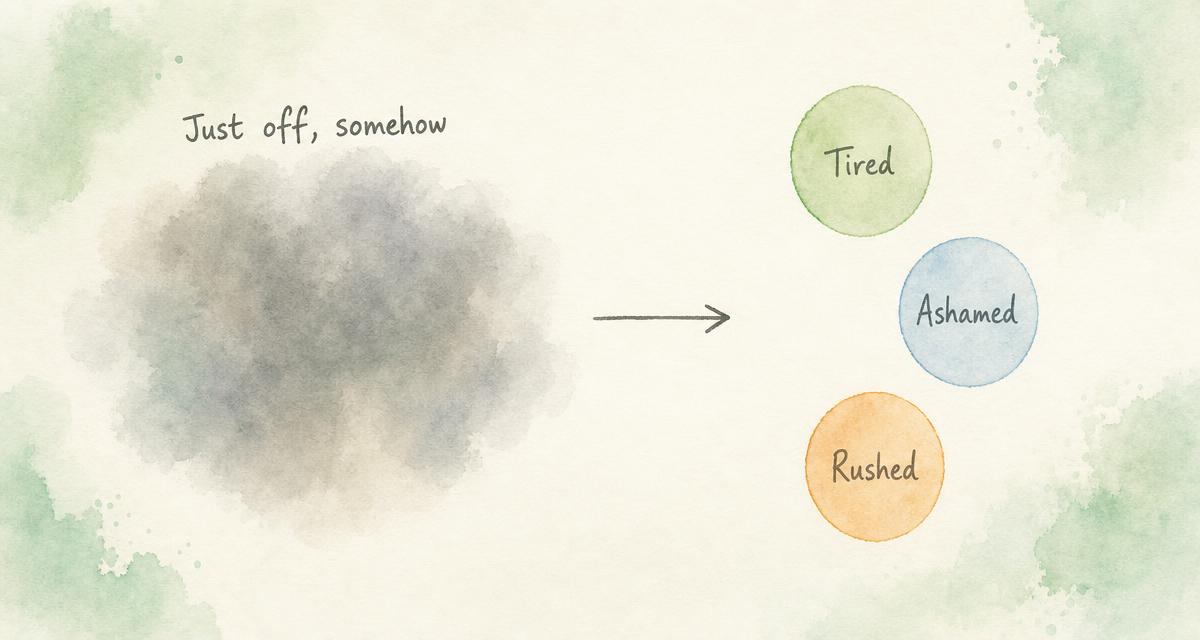
There's a second line of work on how finely you name things. Kashdan, Barrett and colleagues call the ability to distinguish closely related emotional states emotion differentiation, and higher differentiation is associated with a lower tendency to reach for extreme coping — heavy drinking, aggression, self-harm — when distress is severe. Two people can both be "unpleasant"; the one who can tell apart rushed, ashamed and tired has more to work with.
To be careful: neither result promises that naming a feeling will make you feel better. One is a change in brain activity, the other an association with coping. What they support is that the attempt to name is doing something — which is enough to make it worth doing well.
The problem is that nothing comes
Here's where it breaks down.
Close your eyes and resolve to "put my feelings into words," and almost nothing arrives. What does arrive is "bad" or "off," which you already knew.
That isn't a shortage of vocabulary. The search space is too large. English has hundreds of words for emotional states, and you're trying to locate the one that fits, from all of them, at eleven at night, while tired. That is not a reasonable task.
We've made the same argument twice already. Journaling doesn't stick because of the blank page, and you don't have to invent your own reflection questions. Naming a feeling works the same way: choose from what's laid out, rather than searching from nothing.
Usefully, feelings come with maps.
Map one — fix the position
The psychologist James Russell proposed placing emotions on two axes: pleasant or unpleasant, and high energy or low. Cross them and emotions arrange themselves around a circle.
That gives you a two-question procedure. Decide pleasant or unpleasant. Then decide high energy or low. Four quadrants, and you're in one of them.
| Where you are | Roughly these |
|---|---|
| Unpleasant, high energy | Worried · Alert · Annoyed · Afraid |
| Pleasant, high energy | Excited · Happy · Energetic · Joyful |
| Unpleasant, low energy | Sad · Bored · Gloomy · Tired |
| Pleasant, low energy | At ease · Cheerful · Relaxed · Satisfied |
Run "off, somehow" through those two questions. Unpleasant, and no energy in it. That puts you bottom-left. Sad, bored, gloomy, tired — and often one of them lands. Sometimes it's "tired, that's all." Sometimes it turns out to be closer to bored, which is more interesting information.
The sixteen feelings in Reflection Cloud's morning check-in are laid out in a four-by-four grid because that grid is the circle, flattened. The axes are labeled on screen: Unpleasant to Pleasant across, High Energy to Low Energy down.
You pick one. The morning hasn't happened yet, so a single point is all there is to fix.
Map two — choose the intensity
There's a second map, cut a different way.
Robert Plutchik proposed that emotions come in eight basic families, each with degrees of intensity. Within the anger family, annoyance and rage call for completely different next moves.
| Family | Mild → Middle → Strong |
|---|---|
| Anger | Annoyance → Anger → Rage |
| Fear | Apprehension → Fear → Terror |
| Sadness | Pensiveness → Sadness → Grief |
| Disgust | Boredom → Disgust → Loathing |
| Joy | Serenity → Joy → Ecstasy |
| Trust | Acceptance → Trust → Admiration |
| Anticipation | Interest → Anticipation → Vigilance |
| Surprise | Distraction → Surprise → Amazement |
What this map gives you is the ability to set the volume yourself. Writing "I was angry" makes the evening sound enormous when it was really annoyance. It runs the other way too: something you waved off as "a bit unpleasant" turns out, once the options are in front of you, to have been closer to disgust.
On the fact that it leans unpleasant
Count those twenty-four and you get twelve on the difficult side, nine on the pleasant side, and three in the surprise family that go either way. Next to Russell's sixteen, which split eight and eight, that isn't balanced.
Plutchik's own account frames the eight families as adaptations needed for survival. Fear protects, anger confronts, disgust rejects, sadness reconnects you with what's lost. From that position he doesn't sort them into good and bad — they persisted because they were useful.
Separately, the finding that bad carries more weight than good is well established. Baumeister and colleagues and Rozin and Royzman arrived at it independently in 2001: bad events, bad emotions and bad feedback have more impact than good ones of the same size, consistently enough to call it a general principle.
Those are two different claims. Where they meet is the practical part: if unpleasant states hit harder, the unpleasant side is where you need more resolution. "Glad" often covers it. "Bad" tells you nothing. Plutchik's wheel being heavy on the difficult side happens to fit that.
Two at night
Reflection Cloud's evening check-out lets you pick two from those twenty-four — deliberately different from the morning's one-of-sixteen.
A day's worth of feeling is rarely one color. "Glad, and also wrung out." "Relieved, but the worry is still there." Force it to one and the one you didn't pick stops having happened.
Plutchik's model also treats complex emotions as combinations of the basic families, so allowing two matches the shape of the thing.
That's why the two screens use different maps. The morning needs one position fixed. The evening needs enough resolution to reach a whole day's worth of feeling. We chose that over keeping the options symmetrical.
On the days no name fits
The maps don't always work.
When they don't, "I don't know" is a complete entry. "Unpleasant, no energy, and that's as far as I get" is a real record. Forcing a name on it and painting over the state with the wrong word costs more than leaving it.
Read back six months later, a run of days that say "I don't know" tells you something. That no name fit is itself the record.
Reflection Cloud is a five-minute reflection app for mornings and evenings: pick from what's laid out, write a little. It's free to use, and what you write is yours alone.
On the nights when the naming is the hard part, use it as a map.
Research referenced
- Lieberman, M. D., Eisenberger, N. I., Crockett, M. J., Tom, S. M., Pfeifer, J. H., & Way, B. M. (2007). Putting feelings into words: Affect labeling disrupts amygdala activity in response to affective stimuli. Psychological Science, 18(5), 421–428.
- Kashdan, T. B., Barrett, L. F., & McKnight, P. E. (2015). Unpacking emotion differentiation: Transforming unpleasant experience by perceiving distinctions in negativity. Current Directions in Psychological Science, 24(1), 10–16.
- Russell, J. A. (1980). A circumplex model of affect. Journal of Personality and Social Psychology, 39(6), 1161–1178.
- Plutchik, R. (1980). Emotion: A Psychoevolutionary Synthesis. Harper & Row.
- Baumeister, R. F., Bratslavsky, E., Finkenauer, C., & Vohs, K. D. (2001). Bad is stronger than good. Review of General Psychology, 5(4), 323–370.
- Rozin, P., & Royzman, E. B. (2001). Negativity bias, negativity dominance, and contagion. Personality and Social Psychology Review, 5(4), 296–320.
These are studies of emotion classification and of putting feelings into words. None of them tested Reflection Cloud.